The race to define modern software now runs through five labs, and the infrastructure beneath them. Here’s who they are, and how to turn that into an engineering advantage.
Ask five people “who are the Big 5 in AI?” and you may get two completely different — yet equally correct — answers. For CTOs, founders, and engineering managers, however, that’s more than trivia. In fact, choosing among these players has quietly become an architecture decision that shapes how fast you ship and how locked in you become.
Quick answer
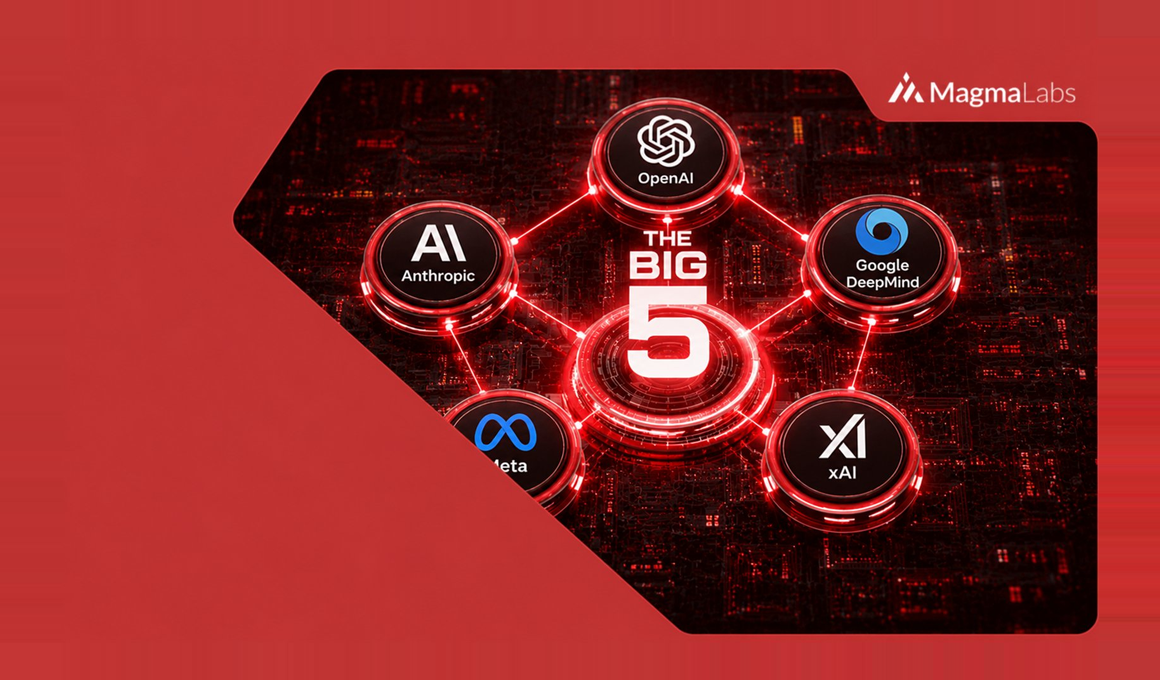
There are two valid “Big 5” lists in 2026. First, the frontier labs that build the models: OpenAI, Anthropic, Google DeepMind, Meta, and xAI. Second, the infrastructure power group beneath them — cloud, chips, and distribution — namely Microsoft, Google, Amazon, NVIDIA, and Meta. For this guide, therefore, we focus on the model builders, because those are the engines your product actually runs on.
Builders vs. backbone
By 2026, AI has split into two layers. On one side, the builders design the frontier models. On the other, the backbone supplies the compute and reach that make those models usable at scale. Naturally, the two overlap — Google and Meta appear on both lists, and NVIDIA quietly powers nearly everyone. Still, your day-to-day decisions live in the builders layer, so that’s where we’ll spend most of our time.
The Big 5 AI labs in 2026
Each of these five shipped a new flagship in the first half of 2026. As a result, the gap between them is now measured in weeks, not generations.
1OpenAIGPT-5.5 · ChatGPT · Codex
First, OpenAI made generative AI mainstream, and it still owns the most consumer attention. Its flagship, GPT-5.5 (April 2026), leans hard into agentic coding through Codex, as well as models that run on their own for hours. Moreover, at a valuation around $852B, the company is racing toward an IPO.
2AnthropicClaude Opus 4.8 · Claude Code
Meanwhile, Anthropic has become the developers’ favorite — and, as of late May 2026, the most valuable AI startup at roughly $965B, ahead of OpenAI. Notably, surging demand for Claude Code pushed its revenue run rate near $47B. In addition, its newest model, Claude Opus 4.8, leads on coding and long-horizon agentic work, and Claude now runs across AWS, Azure, and Google Cloud.
3Google DeepMindGemini 3.5 · Vertex AI
When it comes to distribution, however, no one matches Google. The Gemini 3.5 family (May 2026) is built for agentic, long-horizon work. Furthermore, Gemini reaches users everywhere Google already lives — Search, Workspace, and Android — while Vertex AI makes it an enterprise checkbox. In fact, the API now processes more than a trillion tokens a day.
4MetaLlama 5 · open weights
Meta, by contrast, plays a different game: it gives the models away. Llama 5 (April 2026), for example, continues the company’s frontier-class open-weight strategy, so teams can self-host and fine-tune with no per-token lock-in. As a result, Llama-powered Meta AI reaches billions of people across WhatsApp, Instagram, and Facebook. To be precise, though, it is open-weight, not fully open-source.
5xAIGrok 4 family · native to X
Finally, xAI is the youngest of the five and the fastest-moving. Because the Grok 4 family is embedded in X, it has native, real-time access to the social web. Then, in February 2026, SpaceX acquired xAI at around $250B, pairing one of the largest GPU clusters with the deepest social-media integration in AI.
Beyond the five, meanwhile, several challengers keep reshaping the edges: DeepSeek on cost, Mistral on European open weights, and Zhipu AI in China. Ultimately, any ranking — including this one — is only a snapshot.
What this means for your engineering team
With five credible providers overtaking each other almost monthly, the old playbook no longer works. Instead of picking one vendor and committing, therefore, the smart move is to treat models as interchangeable parts — and to design for it from the start.
In practice, that points to three disciplines worth building into your stack:
- First, design for portability. Abstract your model calls and lean on open standards, so you can swap providers without rewrites — see our guide to AI agents.
- Second, route by task and cost. For instance, send cheap, repetitive work to smaller or open-weight models, and reserve frontier models for production-critical reasoning.
- Finally, evaluate before you trust. After all, benchmarks are marketing until you’ve run your own evals on your own workloads.
In short, this is exactly what our teams help clients navigate — from AI engineering services and custom software development to staff augmentation. So if you’re weighing where these models fit, see how we’ve helped other teams ship with AI without betting the company on one vendor.
Put the Big 5 to work
Not sure which model belongs in your stack?
MagmaLabs helps startups, scale-ups, and enterprise teams choose, integrate, and operationalize the right AI models — safely and at scale.
FAQ: The Big 5 in AI
Who are the Big 5 in AI?
In short, there are two common answers. First, the Big 5 frontier labs building the models are OpenAI, Anthropic, Google DeepMind, Meta, and xAI. Second, the Big 5 infrastructure companies powering AI are Microsoft, Google, Amazon, NVIDIA, and Meta.
What is the most valuable AI company in 2026?
Among AI-native startups, Anthropic became the most valuable in late May 2026 at roughly $965B — ahead of OpenAI at about $852B. By overall market cap, however, public giants like NVIDIA and Microsoft are far larger, though they sit in the infrastructure category rather than as pure model labs.
What is the best AI model in 2026?
Honestly, there is no single winner. For example, Claude Opus 4.8, GPT-5.5, and Gemini 3.5 trade the lead on coding and agentic tasks, while Llama 5 leads for open-weight self-hosting and Grok 4 is strongest for real-time data. Ultimately, the best model depends on your task, budget, and constraints.
How should my company choose between the Big 5?
In short, don’t marry one vendor. Instead, abstract your model layer for portability, run your own evaluations on real workloads, and route tasks to the most cost-effective capable model. Above all, factor in compliance and data residency.
The bottom line
Ultimately, the Big 5 in AI have turned model selection into a core engineering decision. The advantage in 2026, therefore, does not come from picking the “best” one. Instead, it comes from building systems flexible enough to use the right model for each job and to swap providers as the leaderboard shifts. In short, that is disciplined work, not hype — and it is exactly the kind of work MagmaLabs is built for.
References
- OpenAI: Introducing GPT-5.5.
- AP / Al Jazeera: Anthropic soars to a $965B valuation, leapfrogging OpenAI.
- Google: Gemini 3.5: frontier intelligence with action.
- Meta: The Llama herd & Llama 5 coverage.
- Analytics Insight: AI software companies to watch in 2026.
Figures reflect public reporting as of late May 2026 and change quickly.