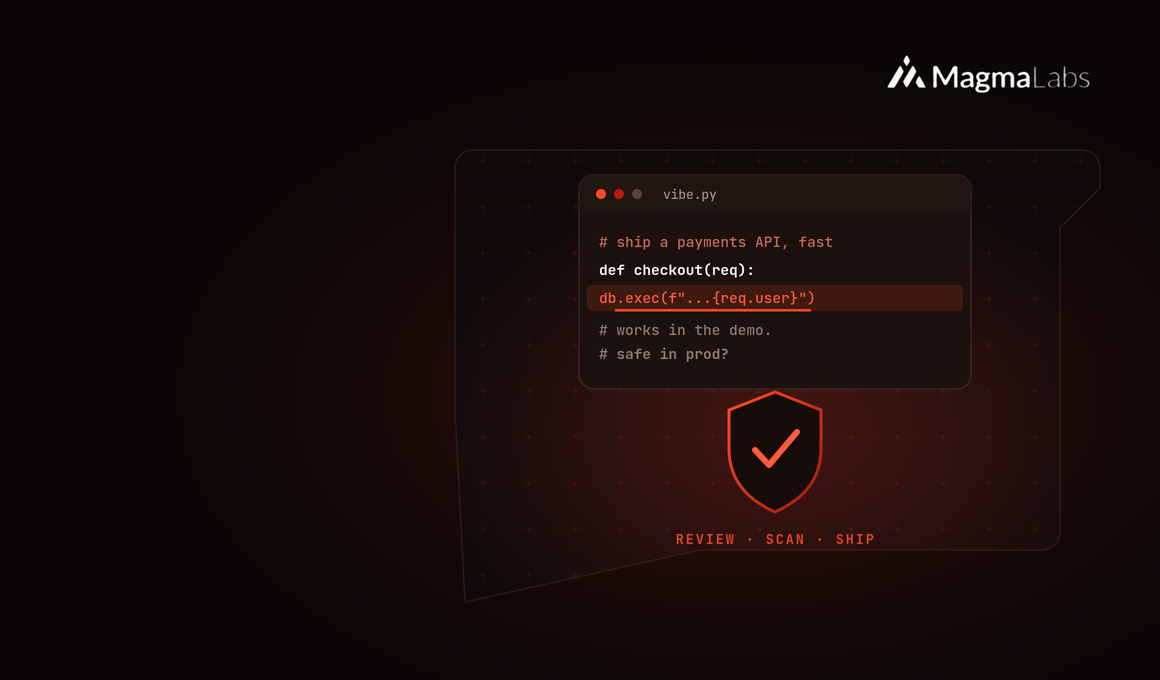
AI writes a huge share of the world’s code in 2026 — fast, fluent, and often unreviewed. So before it reaches your users, here’s the honest answer on whether vibe coding belongs in production, and how to make it safe.
Vibe coding has gone from a buzzword to a default. In fact, by 2026 the vast majority of developers use AI coding tools daily, and a large and growing share of new code is AI-generated. Naturally, engineering leaders are asking the obvious question: can we trust this code in production? Let’s answer it directly, then make it practical.
Quick answer
Yes — but only with guardrails. Raw, unreviewed vibe coding is not production-safe: roughly 45% of AI-generated code ships with a known vulnerability. However, with human review, automated security scanning, and clear ownership, AI-assisted development can absolutely run in production. The danger isn’t the AI — it’s shipping its output without the checks you’d apply to any other code.
What “vibe coding” actually means
Coined by Andrej Karpathy, vibe coding is prompt-driven development: you describe what you want in plain language, and a tool like Claude Code, Cursor, Lovable, or Bolt generates the code, config, and sometimes the whole app. As a result, the developer’s role shifts from author to director. That shift is powerful for speed — yet it also removes the friction (writing, reviewing, arguing) that traditionally caught security and design flaws before release.
How risky is AI-generated code? The data
The numbers are sobering, and they come from independent security research rather than vendor hype.
Crucially, the problem also scales. Georgia Tech’s Vibe Security Radar tracked CVEs attributed to AI-generated code climbing sharply through 2026, while a large scan of thousands of deployed vibe-coded apps surfaced thousands of critical vulnerabilities, hundreds of exposed secrets, and real PII left in the open.
Why it breaks in production
Importantly, the core issue isn’t one bad line of code. As Trend Micro frames it, the real risk is uncontrolled software change: AI lowers the cost of producing code so much that volume and speed outrun the review, ownership, and policy controls meant to govern it. Consequently, a few failure modes show up again and again.
Real incident · Feb 2026
Moltbook, a social platform reportedly built entirely through vibe coding, made security news when researchers at Wiz found a misconfigured database left open to the internet — exposing roughly 1.5 million authentication tokens and 35,000 email addresses. The root cause wasn’t a sophisticated hack; it was AI-scaffolded infrastructure deployed without a security review.
How to make vibe coding production-safe
The good news: none of these risks are new, and the fixes are well understood. Essentially, you reintroduce just enough friction to govern speed — without killing it. Here’s the pipeline that works.
In practice, the highest-leverage habits are simple:
- Treat AI code as untrusted by default. Therefore, read it, test it, and run static analysis before it merges — exactly as you would for third-party code.
- Mandate human review and clear ownership. Every AI-generated change needs a person who can explain and maintain it, which prevents “comprehension debt.”
- Automate the boring guardrails. For instance, real-time secret detection, dependency (SCA) checks, and CI/CD security gates catch the most common failures.
- Prompt for secure defaults. A line like “use parameterized queries and validate all inputs” goes a long way; meanwhile, never paste secrets into a prompt.
- Reserve manual coding for critical paths. Above all, keep authentication, payments, and permissions under human control, and start AI in non-critical systems first.
This is precisely where an experienced partner helps. At MagmaLabs, our AI engineering services and custom software development teams build these guardrails into the workflow, and our staff augmentation drops senior engineers in to own review and architecture. If you want to see it in action, explore our case studies. For the bigger picture on autonomous tooling, our guide to AI agents is a useful next read.
Ship AI-assisted code with confidence
Vibe coding fast — without the production blowups
MagmaLabs helps engineering teams put the right review, security, and governance around AI-generated code, so speed never becomes a liability.
FAQ: Vibe coding in production
Is vibe coding safe for production?
It can be — but not on its own. Unreviewed AI-generated code is risky, since roughly 45% contains a known vulnerability. With mandatory human review, automated security scanning, clear ownership, and proper deploy controls (RBAC, audit logs, secrets management), vibe coding can run safely in production.
What are the biggest risks of AI-generated code?
The most common are hardcoded secrets, broken access control, hallucinated dependencies (“slopsquatting”), and unsafe defaults shipped without review. Underlying all of them is “uncontrolled software change” — AI produces code faster than teams can govern it.
Can you vibe code an enterprise application?
Yes, for the right use cases and with governance. Many teams use a “graduate workflow”: prototype quickly in tools like Bolt or Lovable, then productionize in Cursor or Claude Code under review. Enterprises add an approved-tool list, code classification, and compliance mapping (SOC 2, HIPAA, PCI DSS) before anything touches real data.
How do we let our team vibe code safely?
Start small and non-critical, treat AI output as untrusted, require review and ownership, automate secret/dependency scanning in CI/CD, and keep critical paths (auth, payments) human-written. A phased, governed rollout captures the speed gains without the security gap.
The bottom line
Ultimately, “Is vibe coding safe for production?” is the wrong question. The better one is whether your process can catch what AI gets wrong — at the speed AI now introduces it. Teams that win in 2026 won’t be the ones vibe coding the fastest; instead, they’ll be the ones pairing AI speed with disciplined review, security, and ownership. That combination is exactly what MagmaLabs is built for.
References
- Trend Micro: The real risk of vibecoding.
- BeyondScale: Vibe coding security risks (CVE & scan data).
- Keyhole Software: Vibe coding trends 2026 (adoption & quality data).
- Northflank: Deploying AI-generated apps safely.
- The New Stack: Vibe coding could cause catastrophic “explosions” in 2026.
Statistics reflect public research available as of mid-2026 and continue to evolve. Validate against your own environment before acting.