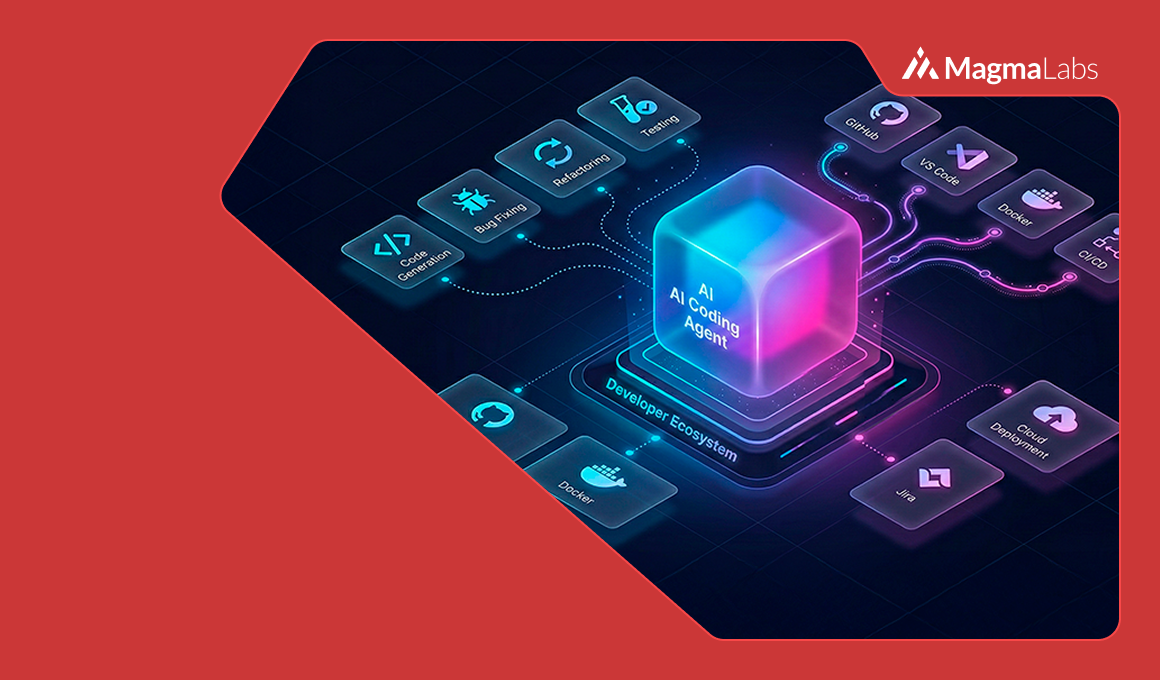
Unlike traditional chatbots, AI agents can plan, decide, and execute actions across tools and systems. In other words, they don’t just generate text — they complete real work.
Why Companies Are Racing to Ship AI Agents
Over the past two years, AI has shifted from simple text generation to action-oriented systems. Initially, most tools focused on writing, summarizing, or answering questions. However, the real transformation began when AI systems started executing workflows.
Today, organizations are moving beyond assistance toward autonomy. Instead of asking users to click through dashboards, agents now interpret goals and take structured actions. As a result, teams reduce operational friction and unlock measurable productivity gains.
From customer support automation to internal DevOps workflows, agentic AI is quickly becoming the new interface layer for enterprise software.
Top Companies Building Products with AI Agents
1. Salesforce – Agentforce
Salesforce introduced Agentforce to embed AI agents directly inside CRM workflows. Rather than functioning as external assistants, these agents operate within sales, service, and marketing environments.
Consequently, businesses can automate case resolutions, generate follow-ups, and execute CRM actions with built-in governance. More importantly, Agentforce emphasizes enterprise-grade permissions and audit trails.
2. Microsoft – Copilot & Copilot Studio Agents
Meanwhile, Microsoft is leveraging its ecosystem advantage. Through Copilot Studio, organizations can design autonomous agents that operate across Microsoft 365, Teams, and Power Platform.
Because these tools already power daily workflows, adoption becomes significantly smoother. In practice, this ecosystem integration often outweighs feature comparisons.
3. ServiceNow – Now Assist AI Agents
In the IT service management world, ticket overload remains a persistent challenge. ServiceNow addresses this issue by embedding Now Assist agents into structured workflows.
As a result, repetitive requests can be triaged, categorized, and resolved automatically. Furthermore, escalation paths remain transparent and controlled.
4. OpenAI – Agent Infrastructure & Tooling
Instead of focusing on one vertical solution, OpenAI provides the foundational building blocks for agent systems. Through tool calling, structured outputs, and orchestration patterns, developers can design production-ready agents.
Therefore, product teams gain flexibility. Rather than adopting a pre-packaged workflow, they can architect agent behaviors tailored to their specific business needs.
5. AWS – Bedrock Multi-Agent Collaboration
AWS approaches agentic AI from a systems perspective. With Bedrock, multiple specialized agents can collaborate under a coordinated architecture.
Consequently, enterprises can deploy complex automation scenarios while maintaining scalability and security standards native to AWS infrastructure.
6. Google Cloud – Vertex AI Agent Engine
Similarly, Google Cloud emphasizes production readiness. Vertex AI Agent Engine focuses on deployment pipelines, monitoring, and compliance.
Notably, observability becomes a first-class concern. Without traceability, even intelligent agents cannot earn enterprise trust.
7. Cognition – Devin
Finally, Cognition’s Devin demonstrates what a fully agent-native product can look like. Rather than supporting workflows, Devin attempts to complete engineering tasks end-to-end.
Although still evolving, this approach highlights a broader shift: the product itself becomes the autonomous system.
Common Patterns Behind Successful Agent Adoption
- Tool integration beats clever prompting. Agents must connect to real APIs and data systems.
- Governance is not optional. Permissions, approval flows, and logging are essential.
- Start narrow, then expand. Focus on one high-friction workflow before scaling.
- Observability drives trust. Enterprises require traceability and performance monitoring.
Frequently Asked Questions
What is an AI agent?
An AI agent is a system capable of autonomously planning and executing tasks across tools and digital environments, often with human oversight.
How is an AI agent different from a chatbot?
While chatbots generate responses, AI agents take actions. In other words, they can update systems, call APIs, and complete multi-step workflows.
How should companies start implementing AI agents?
First, identify a repetitive workflow. Next, integrate structured tool access. Finally, introduce human-in-the-loop approval before expanding automation scope.
Conclusion
AI agents are redefining how modern software delivers value. Rather than navigating interfaces manually, users increasingly define outcomes while intelligent systems execute the work.
At MagmaLabs, we specialize in building scalable AI agent development solutions
that integrate securely with enterprise systems.
If you’re ready to move from experimentation to execution, explore our
AI consulting services and start designing production-ready AI agents today.