Engineering & Growth · Startup Playbook 2026
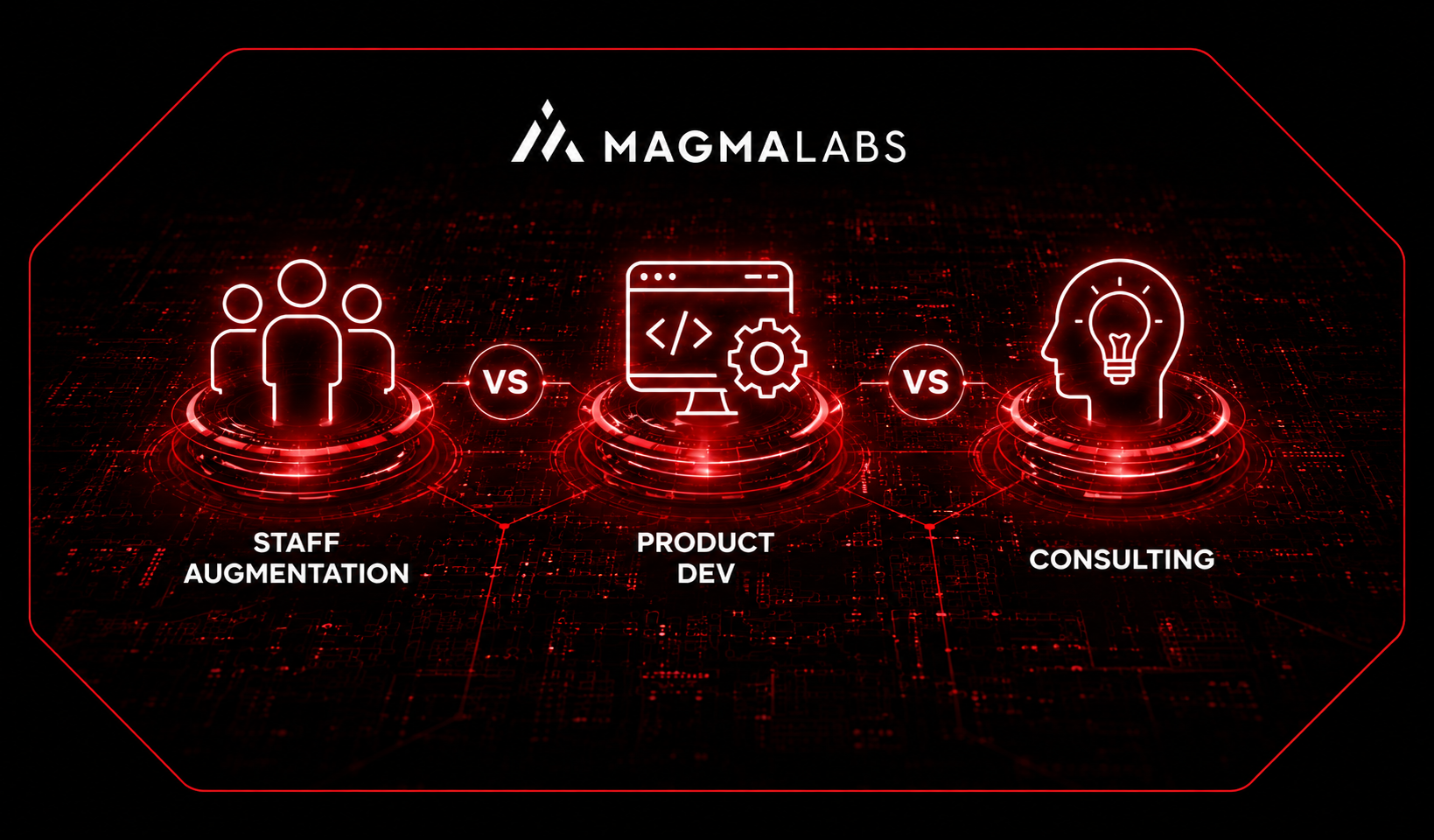
For most startups in 2026, the right model tracks your stage and your biggest constraint: staff augmentation when you have a roadmap and technical leadership but not enough hands; product development (a dedicated, outcome-owning team) when you need to build and ship something new; and consulting when the real problem is strategy, architecture, or direction rather than raw capacity. Many startups use two of the three at once.
Key takeaways
- Staff augmentation = capacity. External engineers plug into your team, on your roadmap, under your management. Fast to scale, but you still own delivery.
- Product development = outcomes. A cross-functional partner owns the build end-to-end. Best when you lack in-house tech leadership or a full team.
- Consulting = direction. Senior expertise for decisions — architecture, stack, AI strategy, due diligence — where a wrong turn is expensive.
- Your stage, in-house leadership, and time horizon matter more than headline hourly rates.
- The models are not mutually exclusive — the smartest startups sequence them as they mature.
Staff Augmentation
Extra vetted engineers on your team, working your roadmap.
Product Development
A dedicated team that owns the build and ships the outcome.
Consulting
Senior guidance on the decisions that shape your product and stack.
The three models compared at a glance
Before we go deep, here’s how the three engagement models differ across the factors founders actually weigh when deciding how to build software in 2026.
| Factor | Staff Augmentation | Product Development | Consulting |
|---|---|---|---|
| What you get | Individual specialists | A full delivery team | Expertise & a plan |
| Who manages the work | You do | The partner does | Advisory only |
| You’re buying | Capacity | Outcomes | Direction |
| Needs in-house tech lead | Yes | Optional | Helpful, not required |
| Speed to start | Days–weeks | Weeks | Days |
| Accountability for results | Shared / yours | The partner’s | Yours (post-advice) |
| Typical pricing model | Per-seat, monthly | Fixed scope or dedicated team | Hourly / retainer / project |
| Relative cost | $$ | $$$ | $$–$$$ |
| Best startup stage | Seed–Series B | Pre-seed–seed & new lines | Any (at decision points) |
Cost tiers are illustrative and vary widely by region, seniority, and scope. Treat them as relative signals, not quotes.
What is staff augmentation — and when does it work?
Staff augmentation means bringing external engineers or specialists onto your existing team. They work under your management, in your tools and processes, on your roadmap. The provider’s job is to supply vetted talent quickly; your job is to direct it. You’re not outsourcing a problem — you’re renting hands (and specific skills) to move faster on work you already understand.
It shines when you have product and technical leadership in place but a capacity gap: a launch deadline, a backlog that’s outpacing your team, or a niche skill you need for a few months rather than forever — mobile, data engineering, DevOps, or a specific framework.
Strengths
- Ramp in days, not the months a full-time hire takes
- Scale up or down as your roadmap shifts
- You keep full control of code, context, and IP
- Cost-effective for temporary or spiky demand
Trade-offs
- You still manage, onboard, and unblock them
- They deliver effort, not guaranteed outcomes
- Context can walk out the door when they leave
- Weak in-house leadership makes it far less effective
Best for: Seed to Series B startups with a technical founder or CTO, a clear roadmap, and a temporary need for more hands or a specific skill.
What is product development (a dedicated team)?
Product development — sometimes called a dedicated team, build partner, or outsourced product engineering — is when a partner owns delivery end-to-end. Instead of individuals slotting into your team, you get a cross-functional unit (product manager, designers, engineers, QA) that takes a problem and ships a working solution. You define the outcomes and priorities; they own the “how” and the delivery risk.
This is the model that gets a non-technical founder from idea to MVP, or lets an established startup spin up a new product line without pulling its core team off the main roadmap.
Strengths
- Accountability for results, not just hours
- A whole team without hiring each role yourself
- Fast, focused path to an MVP or new feature set
- Works even without in-house tech leadership
Trade-offs
- Higher cost than pure augmentation
- Requires clear scope and defined outcomes
- Knowledge transfer must be planned, not assumed
- Vendor lock-in risk if handover is neglected
Best for: Pre-seed and seed founders building an MVP, and scaling startups launching a new product without diverting the core team.
What is technology consulting for startups?
Consulting is buying expertise and direction rather than execution. Engagements are typically short and high-leverage: an architecture review before a rewrite, choosing the right stack, a cloud-cost or security assessment, technical due diligence for a fundraise, or an AI-adoption strategy. The deliverable is a decision you can trust — an assessment, a roadmap, a recommendation — sometimes backed by a prototype.
You reach for consulting when the cost of getting a decision wrong dwarfs the cost of the advice. It doesn’t build the product for you; it makes sure you build the right one.
Strengths
- Senior expertise on demand, without a senior hire
- Avoids expensive architectural and hiring mistakes
- Short, focused engagements with fast impact
- Independent, outside perspective on hard calls
Trade-offs
- Usually doesn’t ship the thing itself
- Value depends entirely on execution afterward
- Advice can gather dust without an owner
- Higher hourly rates than delivery work
Best for: Any stage facing a high-stakes decision — scaling architecture, a rewrite, due diligence, entering a regulated space, or adopting AI.
How the costs compare in 2026
The cheapest model on paper is rarely the cheapest in practice, because each one charges for something different. The real question isn’t the hourly rate — it’s the total cost of getting to your outcome, including your own team’s time.
Staff augmentation is usually billed per seat, per month, and reads as the most affordable line item. But remember you’re also spending your team’s management time to direct it. Product development costs more up front — you’re paying for a whole team plus delivery accountability — but it absorbs coordination and risk you’d otherwise carry yourself. Consulting can look expensive per hour, yet a few days of the right guidance often pays for itself many times over by preventing a six-figure mistake.
A useful rule of thumb: pay for capacity when you already know exactly what to build, pay for outcomes when you need it built and shipped, and pay for direction when the stakes of the decision are high.
This article is general guidance, not financial or investment advice — model your own numbers against your runway and goals.
A decision framework: which model fits your startup stage
If you only take one thing from this comparison, make it this: match the model to where your startup actually is right now.
AdviseBuild Get a short consulting engagement to validate the technical approach, then a product-development partner to ship the MVP.
BuildAugment A dedicated team to build and iterate; add augmentation once you have a technical lead who can direct extra hands.
AugmentAdvise Augment your in-house team to hit the roadmap faster; bring in consulting for scaling architecture and key hires.
Advise Facing a rewrite, a fundraise, a compliance requirement, or an AI bet? Start with consulting before you commit engineering time.
Signals you’re in the wrong model
You’re augmenting but constantly redesigning the work for contractors who lack context — you probably needed a dedicated team. You hired a build partner but keep dictating implementation detail — you actually wanted augmentation. You commissioned a strategy deck that nobody is executing — you needed hands, not advice. Mismatch usually shows up as friction long before it shows up on the invoice.
Can you combine models? (Most startups should)
These aren’t three doors where you pick one and walk through. The strongest approach is often a sequence that matches your maturity: consult to set the direction, build to ship the first version, then augment once you’ve hired in-house leadership and just need to move faster. A single partner who can flex across all three as you grow saves you the cost and risk of re-onboarding a new vendor at every stage.
What’s changing in 2026
Three shifts are reshaping this decision. First, AI-assisted development is compressing team sizes and raising the premium on partners who are genuinely AI-literate — the right small team now outpaces a larger, slower one. Second, founders increasingly want outcome-based engagements over pure time-and-materials, pushing more work toward the product-development model. Third, security, compliance, and data governance have moved from afterthought to selection criteria, which is fueling demand for consulting before anything gets built. The through-line: capability and judgment matter more than raw headcount.
Frequently asked questions
What’s the difference between staff augmentation and outsourcing?
Staff augmentation adds individuals to your own team, under your management and on your roadmap — you stay in control of the work. Traditional outsourcing (closer to the product-development model) hands an entire problem or project to an external team that owns delivery. The short version: augmentation is renting hands; product development is buying outcomes.
Is staff augmentation cheaper than hiring full-time?
For temporary or spiky needs, usually yes — you skip recruiting cost, ramp time, and long-term overhead, and you can scale down when the need ends. For a permanent, core role you’ll keep for years, a full-time hire is often more economical. Match the commitment to how long you actually need the skill.
Which model is best for building an MVP?
Product development. A dedicated, cross-functional team can take you from concept to a shippable MVP without you having to hire and manage each role yourself — especially valuable for non-technical founders. Consulting first can be worth it to validate the technical direction before you commit budget.
Does staff augmentation work for non-technical founders?
Rarely on its own. Augmentation assumes someone on your side can direct, review, and unblock the work. Without in-house technical leadership, a product-development partner (which owns delivery) or a fractional CTO via consulting is usually the safer path until you can hire that leadership.
When should a startup use consulting instead of just building?
When the cost of a wrong decision is high: choosing an architecture you’ll live with for years, planning a rewrite, preparing for technical due diligence in a raise, entering a regulated market, or making an AI bet. A short consulting engagement de-risks the decision before you spend months of engineering on it.
Can I switch between models as my startup grows?
Yes — and you probably should. A common path is consulting to set direction, product development to build the first version, then staff augmentation to scale once you have in-house leadership. Working with a partner who supports all three makes those transitions far smoother.
Work with MagmaLabs
Not sure which model fits your startup?
Tell us where you are and what you’re trying to ship. We’ll help you pick the model — or the sequence — that gets you there without wasting runway.