Founders & Investors · Technical Due Diligence
The term sheet looks great. Then the investor asks for read access to your repo.
That’s technical due diligence, and for AI-built startups it has become the quiet moment where rounds slow down, valuations get renegotiated, or deals stall. Investors aren’t worried that you used AI. Most startups do. They want proof that someone understands, owns, and controls what the AI wrote.
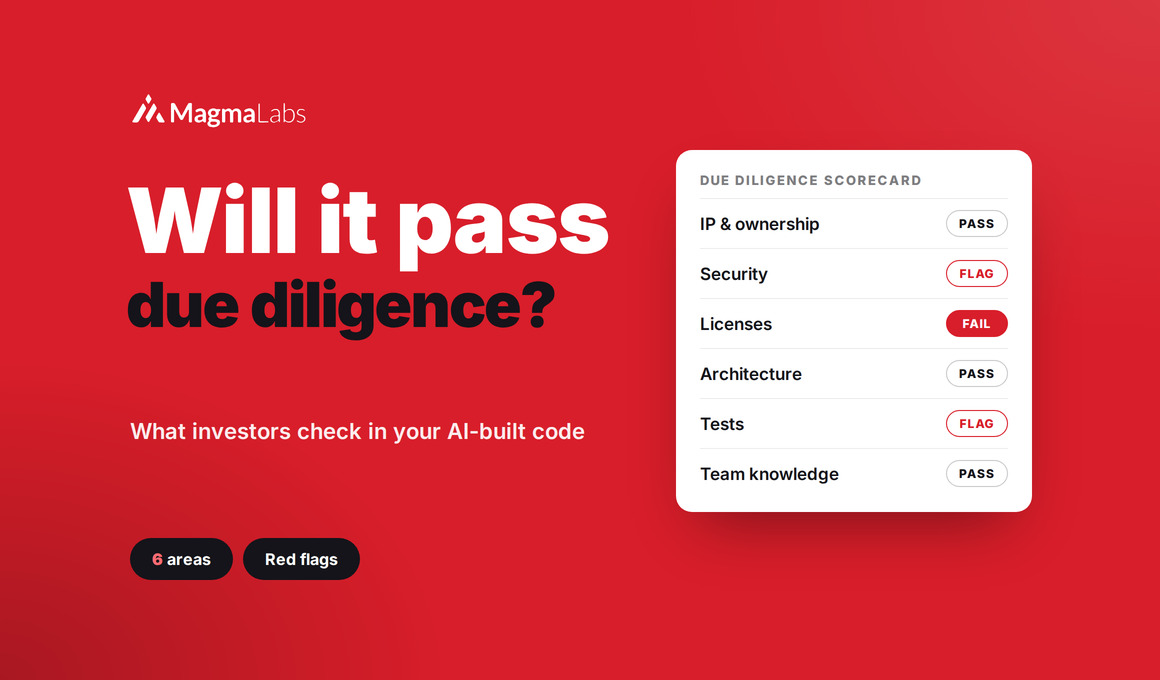
Technical due diligence is an investor’s review of your code, architecture, security, and team before money changes hands. For AI-built startups, reviewers dig into 6 areas: IP and code ownership, security, dependencies and licenses, architecture and scale, tests and delivery, and team knowledge. The biggest deal risks aren’t messy code. They’re license conflicts, exposed secrets, and a team that can’t explain its own product. Fix those before the data room opens.
What is technical due diligence?
Technical due diligence is a structured review of a company’s technology, run by or for an investor or acquirer before a deal closes. It answers one question: will this product hold as the business grows, and what will it cost to fix if it doesn’t?
Why AI-built startups get extra scrutiny
AI is now the default way startups write code. Supabase’s 2026 survey of about 2,000 founders found that 61% have more than half their codebase generated by AI. That changes what reviewers look for.
The clearest signal comes from Black Duck’s 2026 OSSRA report, which audited 947 commercial codebases. License conflicts hit a record 68%, up from 56%, driven partly by “license laundering”: AI assistants reproducing copyleft code without its original license. The same report found that 44% of codebases had critical-risk vulnerabilities, and 93% included components with no development activity in two years.
Most teams aren’t checking. Only 24% of organizations fully evaluate AI-generated code for IP, license, security, and quality risks. Investors know this, so they check for you.
The 6 areas investors check
IP and code ownership
Does the company own every line? Did early contractors sign IP assignments? What do your AI tools’ terms say about generated code?
Red flagAn early freelancer never assigned their code to the company.
Security
Is access control enforced everywhere? Where do secrets live? How is customer data protected?
Red flagAPI keys in the repo history, even if they were deleted later.
Dependencies and licenses
Which open source components do you use, under which licenses, and are they still maintained?
Red flagCopyleft (GPL or AGPL) code inside a proprietary product, often pasted in by an AI assistant.
Architecture and scale
Can the product handle the growth in your financial plan? What breaks first at 10x users?
Red flagThe plan assumes 10x growth, but the architecture was built for a demo.
Tests and delivery
Are critical flows tested? How often do you deploy? How fast can you roll back a bad release?
Red flagNo automated tests on signup, login, or payments.
Team knowledge
Can the team explain how the product works and change it safely without the original author?
Red flagOnly the founder and an AI chat history understand the core logic.
Investors don’t penalize you for using AI. They penalize you for not knowing what it wrote.
How to prepare before the data room opens
| Do this | Why it matters |
|---|---|
| Run a license and dependency scan | License conflicts hit a record high in 2026, and they are far cheaper to fix before a deal than during one. |
| Rotate secrets and fix critical vulnerabilities | Exposed keys and critical flaws are the findings most likely to change terms. |
| Collect every IP assignment | Missing paperwork for early contributors can delay closing. |
| Write a one-page architecture overview | It shows the team understands and controls what it built. |
| Get an independent review first | You fix problems on your timeline, not during the investor’s. |
Walk into due diligence already knowing the answer.
Senior MagmaLabs engineers can review your AI-built product before investors do and tell you plainly what holds, what doesn’t, and what to fix first. No hype, no 80-page report.
Built with AI? Read Is vibe coding safe for production? →
Frequently asked questions
What is technical due diligence?
Technical due diligence is a structured review of a company’s technology, architecture, security, and engineering team, run before an investment or acquisition. It assesses whether the product can support the business plan and what it would cost to fix if it can’t.
When does technical due diligence happen?
Most often before a priced round, especially Series A and later, and before an acquisition. Large enterprise customers may also run a similar security and architecture review before signing.
Does AI-generated code hurt a startup’s valuation?
Not by itself. What hurts is unreviewed AI code: license conflicts, exposed secrets, missing tests, and a team that can’t explain how the product works. Clean, owned, and tested AI-built code passes like any other.
How can founders prepare for technical due diligence?
Run a license and dependency scan, rotate secrets, fix critical vulnerabilities, collect IP assignments, document your architecture on one page, and get an independent review before the investor’s team looks.